Goldberg snark G11
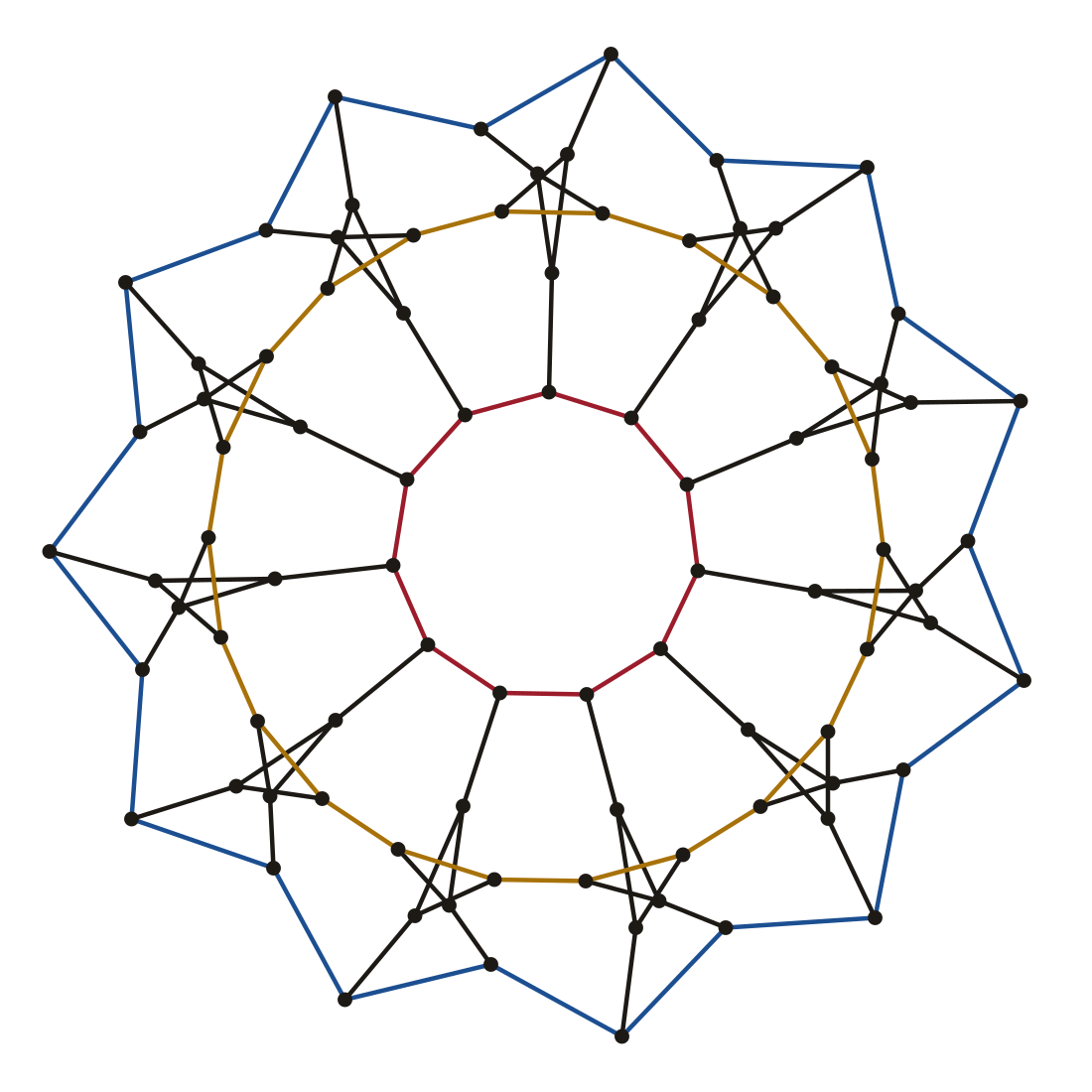
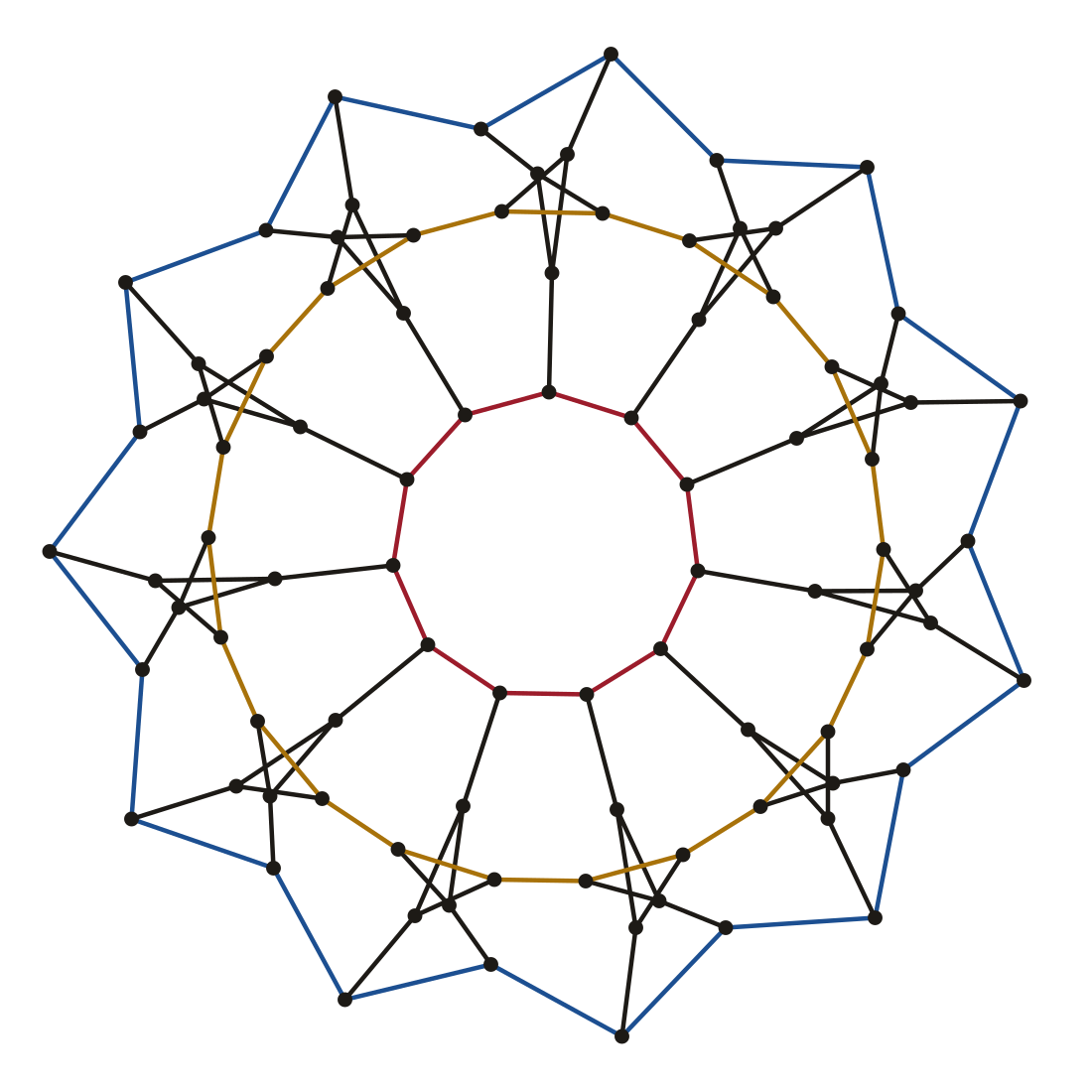
A graph with 88 vertices and 132 edges, made of 11 identical blocks. The largest distance between two vertices is also 11.
The Goldberg snark G11
Drag to turn it, or drag a vertex to move it.Swipe sideways to turn it. Tap a vertex, then drag it or tap a new place, to move it.
| Blocks | 11 |
|---|---|
| Vertices | 88 |
| Edges | 132 |
| Chromatic index | 4 |
| Resistance | 2 |
| Girth | 5 |
| Circumference | 87 |
| Cycles of length 5 | 22 |
| Diameter | 11 |
| Radius | 8 |
| Symmetries | 44 |
| Crossing number | 22 |
| Hamiltonian | No |
| Planar | No |
Background
A graph is a set of points, called vertices, joined by lines, called edges. A graph is cubic if three edges meet at every vertex. A cycle is a closed loop of edges that does not visit any vertex twice.
An edge coloring gives each edge a color, with different colors for edges that meet. Most cubic graphs have one with three colors, called a 3-edge-coloring. A snark is a cubic graph that needs four colors, with some exceptions.
The Goldberg snark Gk is made of k copies of a block of eight vertices, where k is odd and at least 5 [Goldberg 1981]. Links join each block to the next, in an outer ring, a middle ring, and an inner ring. The construction names the vertices of each block a through h.
Diameter
The distance between two vertices is the number of edges in a shortest path between them, and the diameter of a graph is the largest distance between two of its vertices. The diameter of G11 is 11. No other Goldberg snark has a diameter equal to its number of blocks.
A shortest path between two vertices at distance 11.
A shortest path between vertices in distant blocks follows the outer ring, the middle ring, or the inner ring. The outer and middle rings take about two edges per block. The inner ring takes one edge per block, but a path may need up to three edges to reach it and three to leave it.
In G5, G7, and G9, the vertices that are farthest apart are joined by a shortest path along the outer or middle ring, and the diameter is one more than the number of blocks: 6, 8, and 10. In G11, no two blocks are more than five apart, so a path along the inner ring has at most 3 + 5 + 3 = 11 edges. The same argument gives at most (k + 11)/2 for larger Goldberg snarks, and their diameters have been computed to be exactly that up to k = 25. The diameters of G13 and G15 are 12 and 13.
Crossing number
The crossing number of a graph is the smallest number of edge crossings in any drawing of it. The crossing number of G11 is 22, and no larger Goldberg snark has a known crossing number [MathWorld].
Edge coloring
- green
- blue
- gold
- uncolored
In any 3-edge-coloring, the outer and middle links have the same color on one side of each block and different colors on the other side (Lemma 4). Around the ring, places between blocks where those colors are the same would therefore alternate with places where they differ. This is impossible in G11, because the number of places between blocks, 11, is odd.
When three colors are used, at least two edges must be left uncolored in any cubic graph that has no 3-edge-coloring. The figure shows G11 with two edges uncolored, so the most that can be colored is 130 of 132.
By Vizing’s theorem, no cubic graph needs more than four colors, so four are enough. The smallest number of colors in an edge coloring of a graph is its chromatic index, which is 4 for G11. The smallest number of edges that must be left uncolored with three colors is its resistance, which is 2.
Color as many edges as you can so that edges of the same color never meet. Pick a color, then press edges. A vertex turns red if two edges of the same color meet there.
Keyboard: use the left and right arrow keys to move between edges, and the up and down arrow keys to move between blocks. Press 1 for green, 2 for blue, 3 for gold, or 0 to erase.
0 of 132 edges colored.