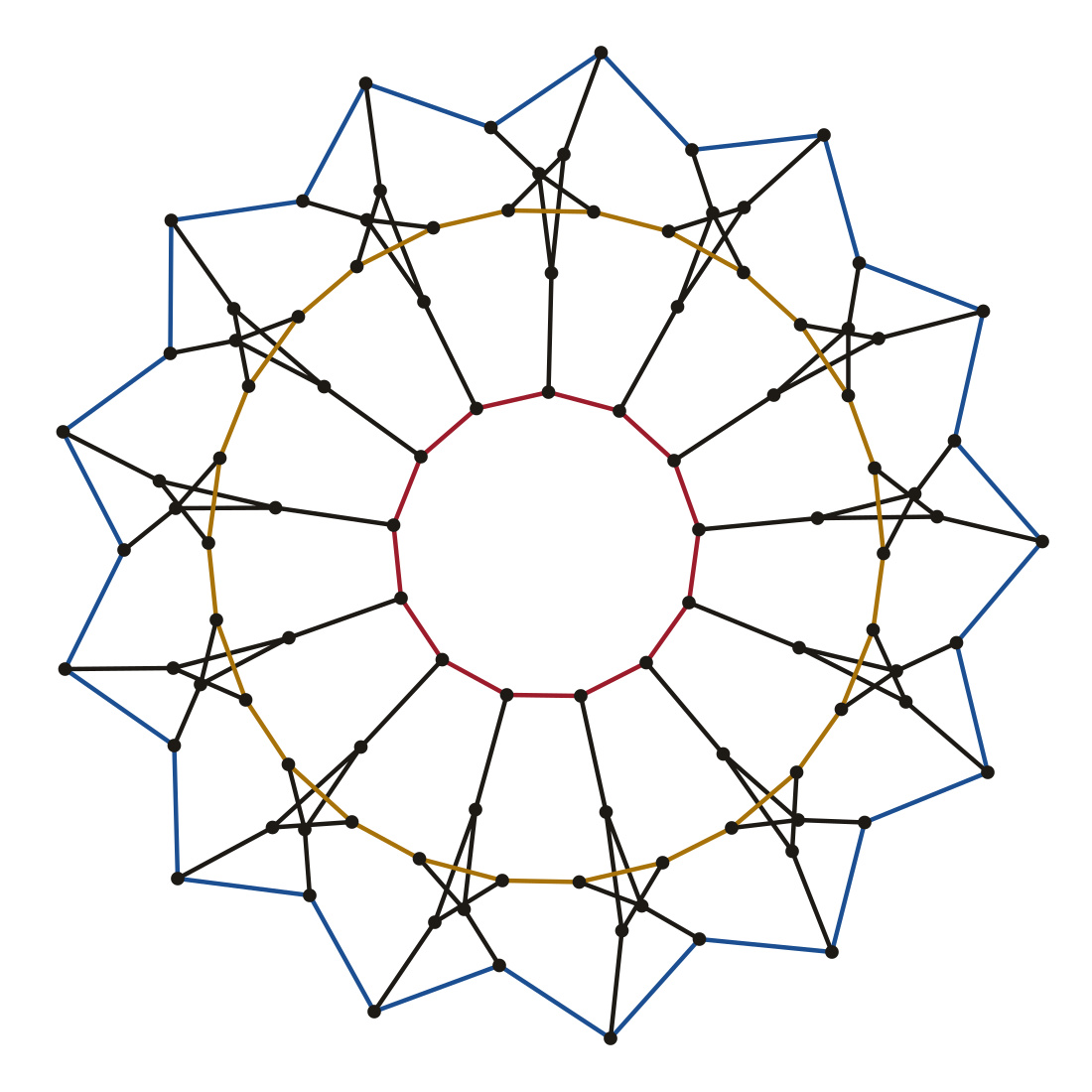
Goldberg snark G13
A graph with 104 vertices and 156 edges, made of 13 identical blocks. It has 52 symmetries.
The Goldberg snark G13
Drag to turn it, or drag a vertex to move it.Swipe sideways to turn it. Tap a vertex, then drag it or tap a new place, to move it.
| Blocks | 13 |
|---|---|
| Vertices | 104 |
| Edges | 156 |
| Chromatic index | 4 |
| Resistance | 2 |
| Girth | 5 |
| Circumference | 103 |
| Cycles of length 5 | 26 |
| Diameter | 12 |
| Radius | 9 |
| Symmetries | 52 |
| Crossing number | 26 (conjectured) |
| Hamiltonian | No |
| Planar | No |
Background
A graph is a set of points, called vertices, joined by lines, called edges. A graph is cubic if three edges meet at every vertex. A cycle is a closed loop of edges that does not visit any vertex twice.
An edge coloring gives each edge a color, with different colors for edges that meet. Most cubic graphs have one with three colors, called a 3-edge-coloring. A snark is a cubic graph that needs four colors, with some exceptions.
The Goldberg snark Gk is made of k copies of a block of eight vertices, where k is odd and at least 5 [Goldberg 1981]. Links join each block to the next, in an outer ring, a middle ring, and an inner ring. The construction names the vertices of each block a through h.
Symmetries
A symmetry, or automorphism, of a graph is a rearrangement of its vertices in which vertices joined by an edge remain joined by an edge. There are 52 symmetries of G13. Each is a combination of:
- a rotation by any number of blocks, for which there are 13 choices;
- a reflection, or no reflection; and
- an exchange of the outer and middle rings, or no exchange.
There are 13 × 2 × 2 = 52 combinations. There are no others. Every block contains two cycles of length 5 that share a path, and no other two cycles of length 5 do (Proposition 6), so a symmetry takes blocks to blocks. Neighboring blocks stay neighbors, so there are 2 × 13 ways for it to rearrange the blocks around the ring. If it leaves every block in place, it leaves every a and b in place, and either leaves c and d in place or exchanges them. That choice determines where the rest of the block goes, as e and h are linked to the next block and f and g to the previous one, and the links then determine every other block.
The same is true of every Goldberg snark, so Gk has 4k symmetries.
Exchanging the outer and middle rings
Exchanging c with d, e with h, and f with g in every block is a symmetry, as vertices that were joined by an edge are still joined by one. It moves the outer ring to the middle ring and the middle ring to the outer ring, and every vertex stays in its block.
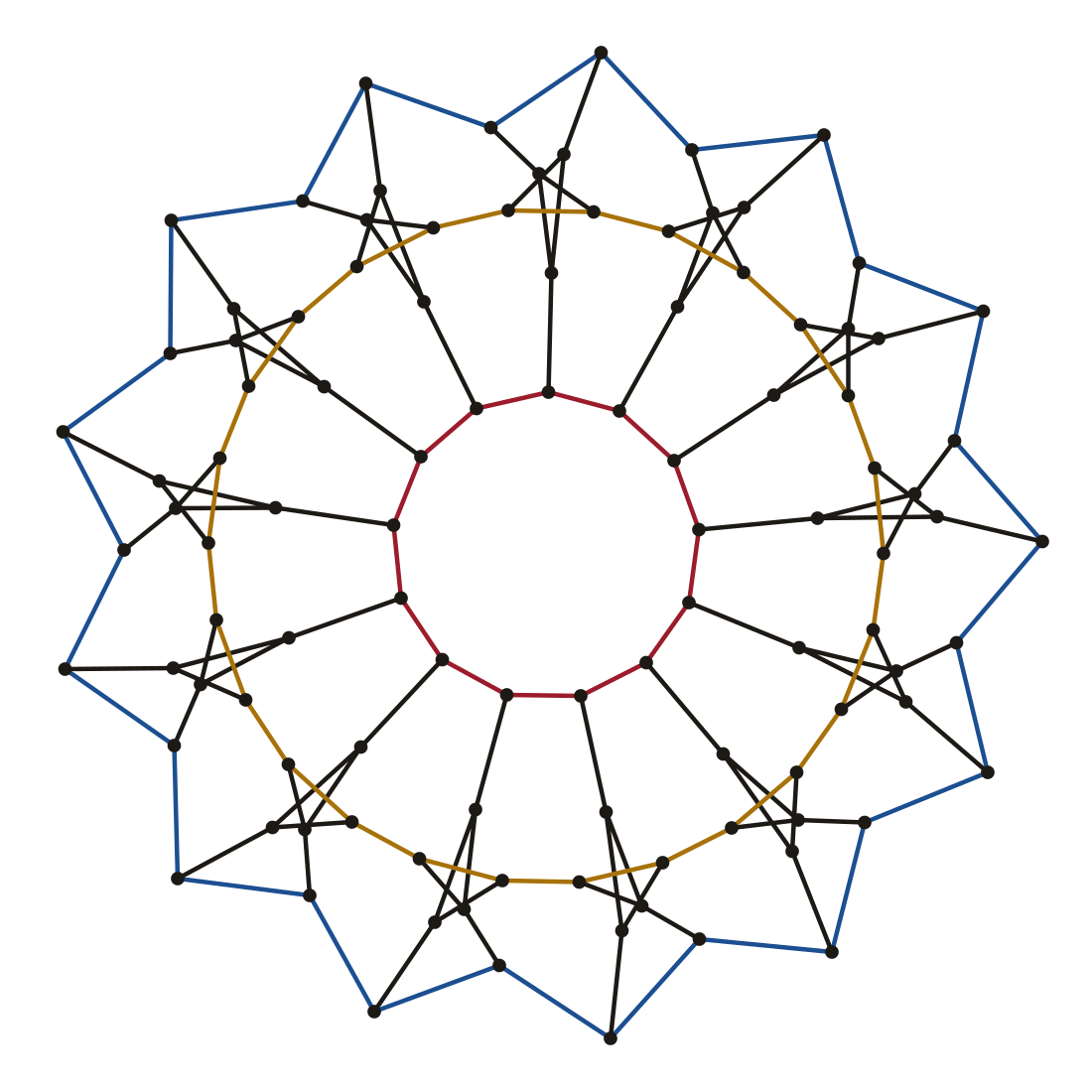
The outer and middle rings of G13.
The outer and middle rings are drawn at different distances from the center, so this symmetry is not visible in the drawing. The rotations are visible, but the reflections are only approximate, because the blocks are not drawn symmetrically.
Edge coloring
- green
- blue
- gold
- uncolored
In any 3-edge-coloring, the outer and middle links have the same color on one side of each block and different colors on the other side (Lemma 4). Around the ring, places between blocks where those colors are the same would therefore alternate with places where they differ. This is impossible in G13, because the number of places between blocks, 13, is odd.
When three colors are used, at least two edges must be left uncolored in any cubic graph that has no 3-edge-coloring. The figure shows G13 with two edges uncolored, so the most that can be colored is 154 of 156.
By Vizing’s theorem, no cubic graph needs more than four colors, so four are enough. The smallest number of colors in an edge coloring of a graph is its chromatic index, which is 4 for G13. The smallest number of edges that must be left uncolored with three colors is its resistance, which is 2.
Color as many edges as you can so that edges of the same color never meet. Pick a color, then press edges. A vertex turns red if two edges of the same color meet there.
Keyboard: use the left and right arrow keys to move between edges, and the up and down arrow keys to move between blocks. Press 1 for green, 2 for blue, 3 for gold, or 0 to erase.
0 of 156 edges colored.