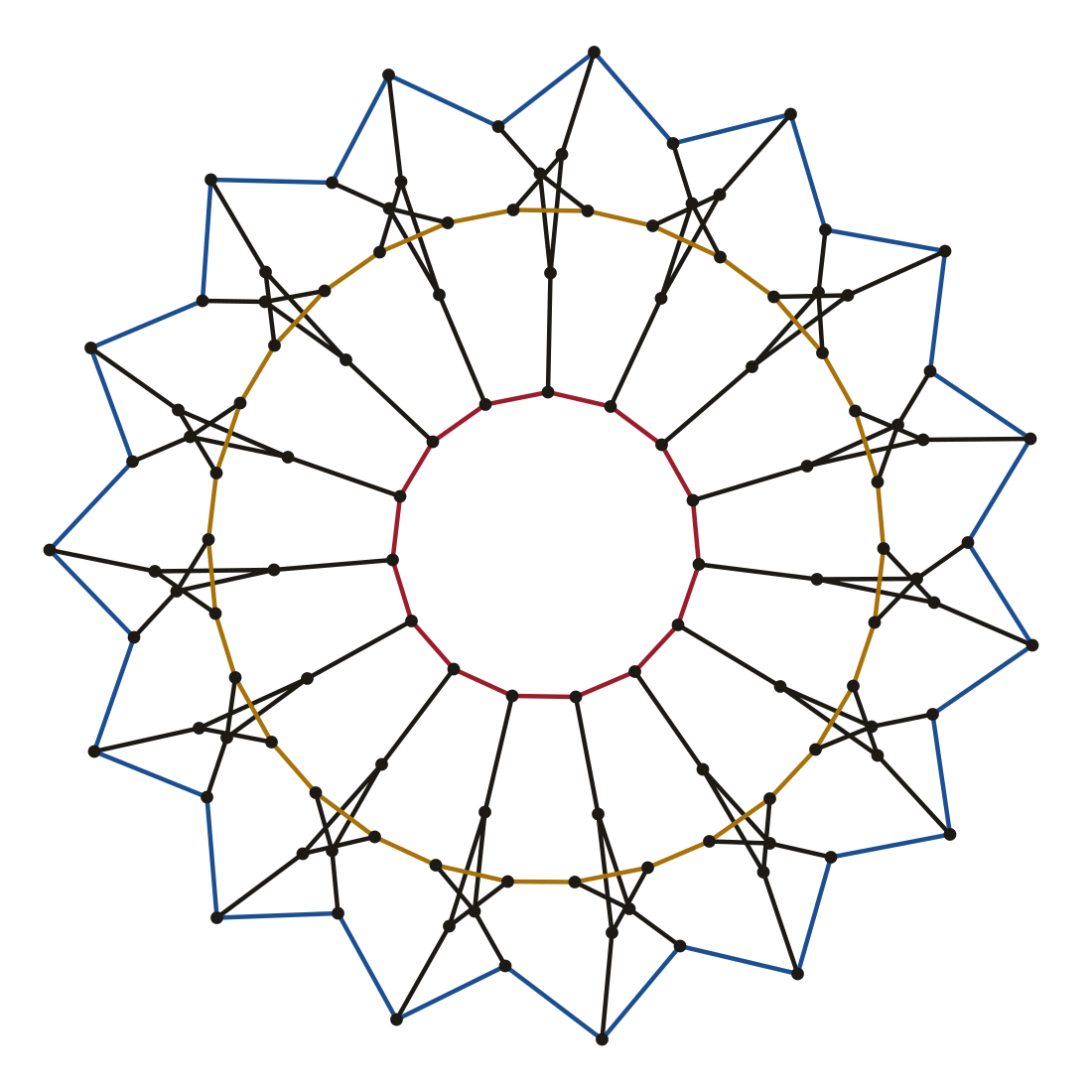
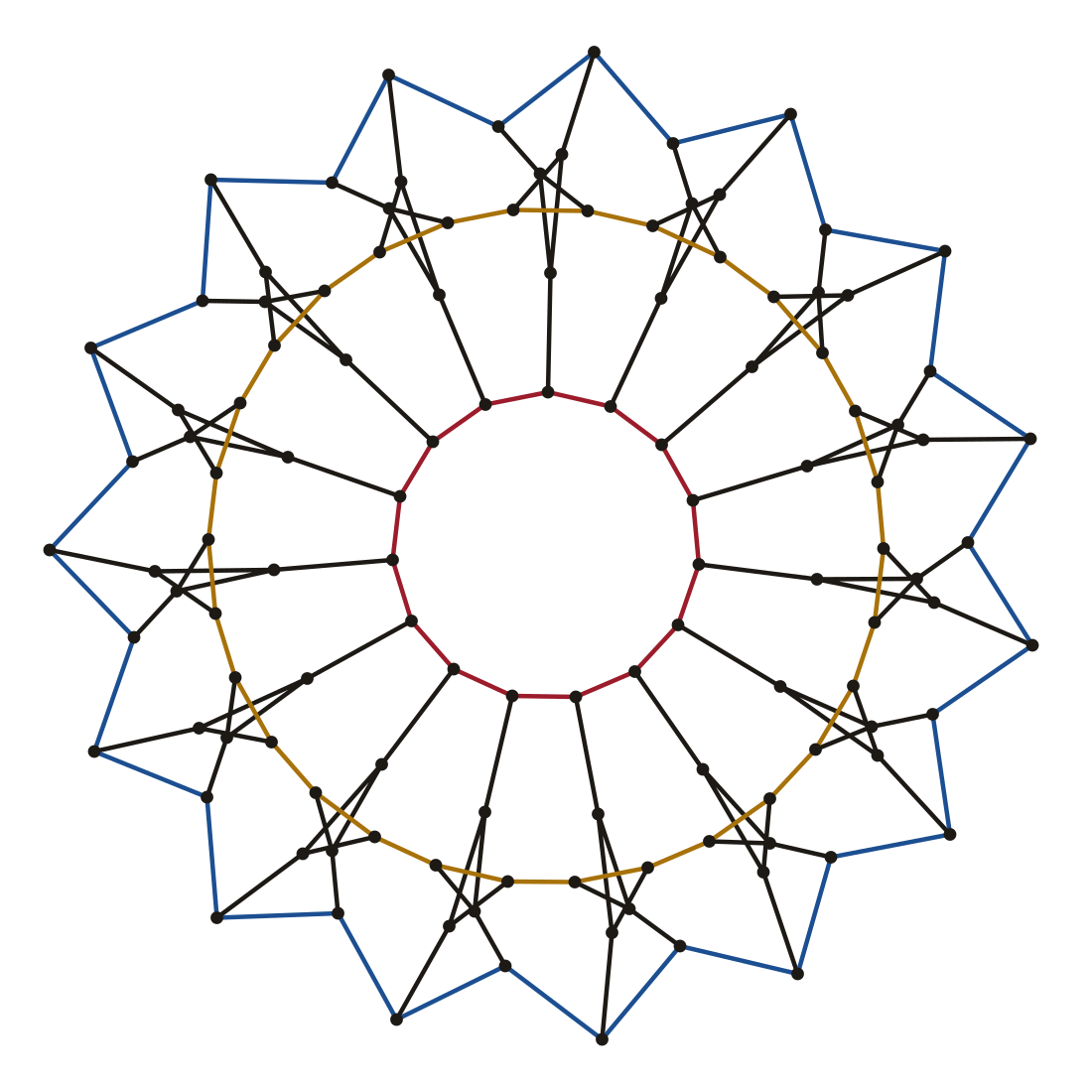
Goldberg snark G15
A graph with 120 vertices and 180 edges, made of 15 identical blocks. Merging the blocks that are five apart gives G5.
The Goldberg snark G15
Drag to turn it, or drag a vertex to move it.Swipe sideways to turn it. Tap a vertex, then drag it or tap a new place, to move it.
| Blocks | 15 |
|---|---|
| Vertices | 120 |
| Edges | 180 |
| Chromatic index | 4 |
| Resistance | 2 |
| Girth | 5 |
| Circumference | 119 |
| Cycles of length 5 | 30 |
| Diameter | 13 |
| Radius | 10 |
| Symmetries | 60 |
| Crossing number | 30 (conjectured) |
| Hamiltonian | No |
| Planar | No |
Background
A graph is a set of points, called vertices, joined by lines, called edges. A graph is cubic if three edges meet at every vertex. A cycle is a closed loop of edges that does not visit any vertex twice.
An edge coloring gives each edge a color, with different colors for edges that meet. Most cubic graphs have one with three colors, called a 3-edge-coloring. A snark is a cubic graph that needs four colors, with some exceptions.
The Goldberg snark Gk is made of k copies of a block of eight vertices, where k is odd and at least 5 [Goldberg 1981]. Links join each block to the next, in an outer ring, a middle ring, and an inner ring. The construction names the vertices of each block a through h.
Coverings
The blocks of G15 can be numbered from 1 to 5 three times, in order around the ring. Merging the blocks that have the same number gives G5, so three blocks of G15 correspond to each block of G5. Every edge of G15 corresponds to an edge of G5, and the three edges at a vertex correspond to the three edges at its counterpart. A graph that corresponds to another in this way is called a covering graph of it. The Goldberg snark G15 is the smallest that is a covering graph of another Goldberg snark.
The three blocks of G15 that correspond to one block of G5.
Since 15 is also a multiple of 3, G15 is a covering graph of the Goldberg graph G3, which is not a snark. Each block of G3 corresponds to five blocks of G15.
Chinese remainder theorem
If the blocks of G15 are numbered from 0 to 14, those of G3 from 0 to 2, and those of G5 from 0 to 4, then block i corresponds to the block of G3 whose number is the remainder of i divided by 3, and to the block of G5 whose number is the remainder of i divided by 5. By the Chinese remainder theorem, no two of the numbers from 0 to 14 have the same pair of remainders, so a block of G15 is determined by the two blocks that it corresponds to.
Edge coloring
- green
- blue
- gold
- uncolored
In any 3-edge-coloring, the outer and middle links have the same color on one side of each block and different colors on the other side (Lemma 4). Around the ring, places between blocks where those colors are the same would therefore alternate with places where they differ. This is impossible in G15, because the number of places between blocks, 15, is odd.
When three colors are used, at least two edges must be left uncolored in any cubic graph that has no 3-edge-coloring. The figure shows G15 with two edges uncolored, so the most that can be colored is 178 of 180.
By Vizing’s theorem, no cubic graph needs more than four colors, so four are enough. The smallest number of colors in an edge coloring of a graph is its chromatic index, which is 4 for G15. The smallest number of edges that must be left uncolored with three colors is its resistance, which is 2.
Color as many edges as you can so that edges of the same color never meet. Pick a color, then press edges. A vertex turns red if two edges of the same color meet there.
Keyboard: use the left and right arrow keys to move between edges, and the up and down arrow keys to move between blocks. Press 1 for green, 2 for blue, 3 for gold, or 0 to erase.
0 of 180 edges colored.